Key Takeaways
- Generative Engine Optimization focuses on earning citations in AI-synthesized responses rather than just ranking blue links.
- Concise paragraphs with direct answers and high semantic density make content easily crawlable for language models.
- Including original statistics, expert quotes, and verifiable facts significantly increases your chances of being cited.
- Strong E-E-A-T signals like verified author credentials and schema markup build essential entity authority.
- Structuring content into clear, self-contained passages allows AI search engines to pull exact answers effortlessly.
Understanding what is GEO in search engine optimization and its core definition
Imagine walking into a massive library where a friendly librarian synthesizes twenty books into a single clear answer for you. For decades, traditional search engines simply handed readers a list of blue links to visit. However, artificial intelligence now summarizes information directly on the results page, changing how people find answers. Therefore, understanding what is GEO in search engine optimization helps content creators adapt to this technological shift (Aggarwal et al., 2024). Consequently, modern writers must structure their articles so artificial intelligence systems easily digest and quote them.
Core Principles of GEO
-
- Optimizing for Citation over Ranking
- Focus on Contextual Entities and Depth
- Emphasis on Information Gain
- Structured & Machine-Readable Formatting
- Multi-Platform Brand Presence
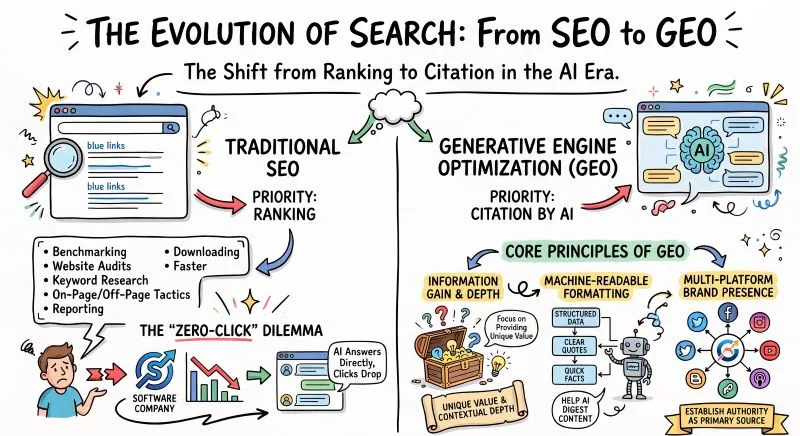
A practical example comes from a software company that published dozens of helpful posts yet saw falling website clicks. Their team realized that search engines were answering questions directly, so users no longer needed to visit individual pages. After learning what is GEO in SEO ,the company restructured its content to provide clear quotes, structured data, and quick facts. As a result, AI tools started citing the company as a trusted primary source across hundreds of automated answers (First Page Sage, 2024). Ultimately, this new approach turned invisible pages into cited authority sources across the internet.
How did search engines evolve from traditional links to generative answers?
Winning at search meant picking keywords and placing them in key positions across a page. Back then, algorithms rated pages based on keyword frequency and external links. However, modern users prefer instant answers without digging through multiple websites. As a consequence, generative engine platforms gather data from top articles and summarize the findings in real time.
This evolution changed how search engines evaluate high-quality information. Today, systems scan for authoritative passages, statistics, and verifiable claims rather than just checking keyword density. Furthermore, readers benefit because they receive direct solutions immediately. Brands must adapt to these intelligent answer engines to stay visible to prospective customers.
Direct citations replacing traditional organic click through rates
When a person searches for a complex topic today, an AI summary usually appears at the top of the screen. Because the summary answers the question instantly, fewer people scroll down to click external links. In fact, industry reports show a noticeable decline in traditional website clicks as generative responses grow (Digital Agency Network, 2026). Although this lowers overall traffic volume, it creates higher brand awareness for cited sources.
When an AI engine highlights your business name, readers naturally trust your expertise. Therefore, earning a citation inside an answer box is becoming more valuable than ranking in position three. Modern creators should focus on becoming the cited source rather than chasing lost clicks. According to recent research from Search Engine Land on AI search visibility, strategic entity building significantly increases source selection rates.
What makes content easily readable for artificial intelligence models
Generative systems prefer content that is straightforward, logical, and backed by clear facts. When writing an article, placing direct answers right under headings helps language models process your meaning quickly. Additionally, using specific numbers and clear definitions makes your statements far easier to cite accurately. Complex or vague language often causes automated systems to skip over otherwise good information.
- Explicit & Machine-Readable Structure
- Clear Heading Hierarchy
- Micro-Formatting
- Semantic HTML / Schema Markup
- High Information Density & Low Fluff
- Direct Answer Placement (BLUF)
- Proprietary & Specific Data
- Entity-Rich Terminology
Furthermore, language models analyze how ideas connect within a single paragraph. Adding transition words like “however,” “therefore,” and “consequently” creates a smooth logical flow. Moreover, including primary research and expert quotes gives the system concrete snippets to pull. By making your prose clean and factual, you increase the likelihood of being featured.
How can brands build real entity authority and genuine trust?
Trust cannot be faked with quick tricks or artificial keyword stuffing. Search engines evaluate author bios, official credentials, and real-world experience before citing any page. Therefore, adding verified author information signals to search systems that your content comes from an expert. Furthermore, linking out to official government databases or academic studies reinforces your overall credibility (SEOlyze, 2026).
Logical Information Layout
- Demonstrating hands-on expertise and original knowledge.
- Building consistent brand associations across external platforms.
- Explicitly mapping brand relationships for LLMs and web crawlers.
- Unfiltered user feedback and real-world consensus.
Building entity authority requires consistent publishing across a specific topic area. When your brand consistently covers a subject deeply, search systems recognize you as a topic expert. Additionally, receiving mentions on reputable news sites strengthens your digital footprint. As documented in the Google AI Overviews developer guidelines, clear structured data helps search algorithms verify entities correctly.
What is the difference between keyword targeting and semantic density
Traditional strategies often relied on repeating one specific target phrase multiple times across a post. In contrast, modern generative systems evaluate semantic density, which means using a network of related concepts. For instance, when explaining what is GEO in search engine optimization, related terms like natural language processing, citations, and passage indexing naturally belong in the discussion.
By covering surrounding concepts, you prove to search engines that your piece offers comprehensive value. Furthermore, this approach prevents robotic prose that turns away human readers. Writing naturally for human readers automatically improves semantic richness for algorithms. Thus, focusing on topic depth always outperforms simple keyword repetition.
Why does content structure matter for passage level indexing
Generative engines do not always read an entire article as a single unit; instead, they extract specific passages. If a single paragraph answers a specific user query completely, the AI engine can retrieve that snippet independently. Therefore, structuring your blog post with clear subheadings and focused paragraphs is essential for discovery. Knowing what is GEO in seo terms means designing self-contained answer blocks for readers and crawlers alike.
Each section of your post should open with a clear summary statement. Following that opening with supporting evidence or data makes the paragraph self-sufficient. Consequently, even if a user only reads one section, the information makes complete sense. This passage-based structure allows AI models to pull exact answers effortlessly.
How do statistics and quotes boost source visibility in AI responses?
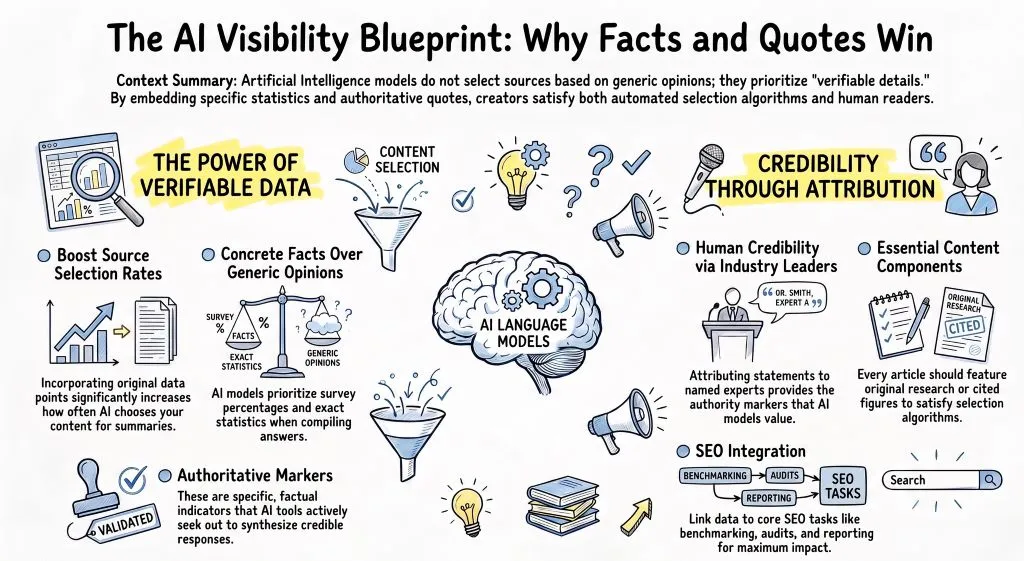
When language models compile answers, they prioritize verifiable details over generic opinions. Incorporating exact statistics, survey percentages, and expert quotes gives the model concrete facts to attribute. Studies demonstrate that adding original data points can significantly boost source selection rates in generated summaries.
Moreover, attributing statements to named industry leaders adds human credibility to your work. When an AI tool synthesizes a response, it actively seeks out these authoritative markers. Therefore, every informative article should feature original research or cited figures. This practice satisfies both human curiosity and automated selection algorithms.
What steps can you take today to optimize existing content
Updating old content is often faster and more effective than creating new pages from scratch. Start by auditing underperforming posts to remove fluff, outdated figures, and wordy intros. Next, reformat key sections into clear question-and-answer pairs that address real user intent. Understanding what is GEO for seo helps you transform generic articles into citable information hubs.
Step 1: Front-Load Answers
Step 2: Convert into Structured Formats
Step 3: Inject Specific Data Points and Expert Attribution
Step 4: Add Contextual FAQ
Step 5: Implement or Update Linked Schema Markup
After refining the text, ensure your technical foundation is solid by checking page loading speeds. Fast, clean websites make it easier for search bots to crawl and index your content efficiently. Additionally, add schema markup to help engines identify the author, publish date, and core subject matter. These simple updates can quickly revive stagnant search visibility.
Generative search change the future of digital marketing
The shift toward AI-synthesized information marks a permanent change in how humanity accesses knowledge online. Rather than competing purely for website clicks, future marketers will compete for brand presence within synthesized answers. As voice assistants and AI engines become integrated into daily life, being the recommended authority will determine business growth.
Embracing this reality allows forward-thinking teams to build long-term digital authority today. By focusing on deep research, absolute clarity, and genuine helpfulness, your content will thrive in this new landscape. Ultimately, mastering what is GEO in search engine optimization empowers your organization to stay visible, trusted, and impactful for years to come.
Frequently Asked Question
What does GEO mean?
GEO is generative engine optimization which comes from LLM citations that gives flexibility in searching.
Is AI SEO called GEO?
At some point AI can be called the Large Language Model which is GEO, the process of finding search terms.From Google Search’s perspective, optimizing for generative AI search is optimizing for the search experience, and thus still SEO.
Can GEO replace SEO?
No. SEO remains the foundation of search visibility. GEO builds on SEO by optimizing how content is used in AI-generated answers. Without strong technical SEO and content structure, there is nothing for AI systems to retrieve or cite.
How is GEO done?
The foundation of GEO is human intent. The era of cramming “best running shoes 2025” into every heading is over. Instead, think about the questions your audience is asking. Focus on Natural Language: What would a real person type or say to their AI assistant?
What are the benefits of GEO?
GEO enables businesses to create content that better aligns with the needs of both the search engine algorithms and the users, which ultimately results in better rankings and increased visibility.
What is GEO for websites?
GEO (Generative Engine Optimization) is the practice of structuring website content so AI platforms and generative search engines (like ChatGPT, Perplexity, or Google AI Overviews) can easily understand, cite, and recommend it.
Navigating the transition from traditional SEO to AI-driven visibility doesn’t have to be overwhelming. By structuring your content around genuine expertise, verifiable data, and reader-first clarity, you can position your brand as an irreplaceable industry authority. Start auditing your core content cluster today, upgrade your entity signals, and ensure your message gets cited where it matters most.
References
Aggarwal, P., Murahari, V., Rajpurohit, T., Kalyan, A., Narasimhan, K., & Deshpande, A. (2024). GEO: Generative Engine Optimization. arXiv preprint arXiv:2311.09735. https://arxiv.org/abs/2311.09735
Digital Agency Network. (2026). Generative Engine Optimization Statistics of 2026 that Marks the End of the “Click Era”. https://digitalagencynetwork.com/generative-engine-optimization-statistics/
First Page Sage. (2024). Generative Engine Optimization (GEO) Strategy Guide. https://firstpagesage.com/seo-blog/generative-engine-optimization-geo-strategy-guide/
SEOlyze. (2026). Generative Engine Optimization (GEO) — The Definitive Guide 2026. https://www.seolyze.com/V4/Blog/generative-engine-optimization-geo-the-definitive-guide-2026/
Related Post
GEO vs SEO: Strategy Builds Better Online Visibility and Growth Today

Recommended Character Count for Meta Description Length